The fly agaric is found across the temperate and boreal forests of the Northern Hemisphere. Here is when and where to expect it.
The trees it needs
Amanita muscaria forms a partnership (mycorrhiza) with tree roots. In Europe its main partners are birch, pine and spruce. You will rarely find it far from these trees — young birch woods and the edges of pine forests are classic places.
The season
In Northern and Central Europe the main season runs from August to October, with a peak in September after warm rain. In the Baltics a few early fruit bodies can appear in July, and mild autumns extend the season into November.
Fly agaric season in the UK
In the UK, fly agaric usually fruits from August to November. Autumn is the main season. The Wildlife Trusts notes that it is often seen under birch, and the Woodland Trust notes that fruiting can extend into early winter.
From egg to flat cap
- Egg stage — a white ball covered by the universal veil.
- Button — the red cap breaks through, densely covered with white warts.
- Domed cap — the classic “toadstool” shape.
- Flat cap — fully open, up to 20 cm, warts sparser.
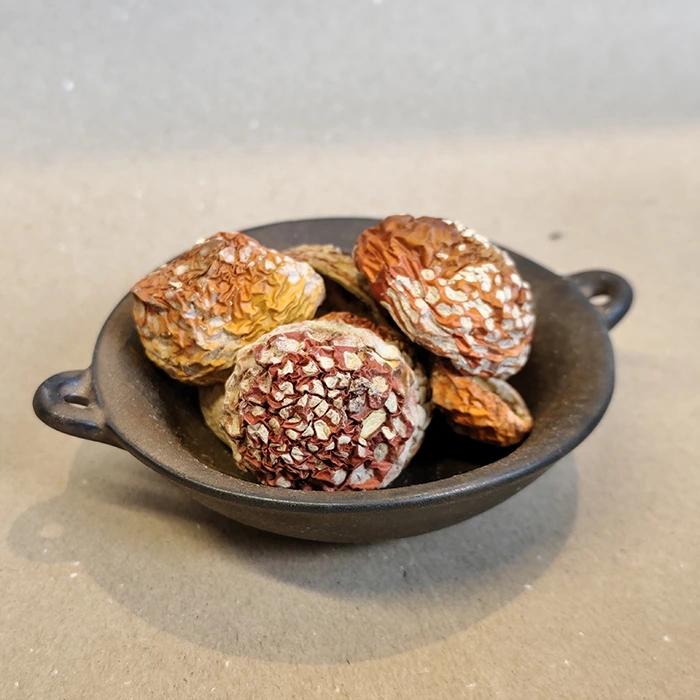
Unopened caps — stages 2–3 — are what we sell as Premium+.
Baltic forests
Latvia is one of the most forested countries in Europe, and both Latvia and Lithuania have large birch and pine stands — ideal fly agaric country. More about Baltic fly agaric.
Products from this guide